

The workout felt fine yesterday. Today, stairs have become a negotiation and sitting down requires strategy. Because the soreness arrived late, it can feel as if something went wrong overnight.
Delayed-onset muscle soreness, or DOMS, commonly follows a new or unusually demanding activity, especially exercise that loads a muscle while it lengthens. It develops after the session rather than during it and usually settles with time. Gentle movement and some recovery methods may reduce how sore you feel, but severe weakness, major swelling, dark urine, or sharp localized pain are not routine DOMS. DOMS review.
Understanding the pattern helps you respond calmly without chasing a cure for a normal adaptation—or missing a real injury.
DOMS is not leftover lactic acid
Lactate changes during and after hard exercise, but it does not remain trapped for days and explain soreness that appears later. DOMS is associated with the response to unfamiliar mechanical load, with muscle and connective-tissue disruption, inflammation, and altered sensitivity all proposed as contributors. No single mechanism explains every symptom.
Lengthening contractions, often called eccentric actions, are common triggers: lowering a weight, descending stairs or hills, or controlling the landing from a jump. Intensity, duration, novelty, and your recent training history all influence the response. Cheung, Hume, and Maxwell.
Soreness is not required for progress. A well-designed session can stimulate strength or fitness without making daily life difficult. Repeatedly chasing extreme soreness may simply make the next useful workout harder to perform.
The timing offers a clue
DOMS is delayed. Tenderness and stiffness often become noticeable hours after exercise and may be most obvious over the next day or two. The worked muscle can feel sensitive when pressed, stretched, or contracted, and temporary losses of range, force, or coordination can occur.
An acute injury is more likely to produce pain during a specific movement or event, especially with a pop, sudden weakness, focal swelling, instability, or bruising. The distinction is not always perfect. If you are changing how you walk or lift because of pain, treat that as a functional warning rather than congratulating yourself on a hard session.
What helps most is often temporary and simple
Light activity can reduce the perception of soreness while you are moving, even if the effect does not last. Try an easy walk, relaxed cycling, or pain-free motion. Reduce intensity and duration for the affected muscles for a day or two instead of testing them with another maximal effort.
A large recovery meta-analysis found average reductions in soreness after several methods, including massage, compression, active recovery, water immersion, contrast water therapy, and cryotherapy. Massage had the largest average effect on soreness and perceived fatigue in that review. However, studies varied and changes in subjective soreness, performance, and blood biomarkers did not always move together. Dupuy and colleagues.
Pick the least complicated option that makes normal movement easier. More sensation is not more recovery.
Stretching can feel good without preventing DOMS
Many people stretch because a sore muscle feels short. Gentle stretching may be comfortable and can support a separate flexibility goal. It should not be sold as a reliable DOMS eraser.
A Cochrane review of randomized and quasi-randomized studies concluded that stretching before or after exercise did not create a clinically important reduction in post-exercise soreness. Herbert and colleagues. Do not force range into a muscle that is guarding or weak just to “break up” soreness.
The more dependable prevention strategy is gradual exposure. Introduce unfamiliar exercises, downhill work, or a large eccentric volume in manageable steps. The body’s response to a repeated bout is often less dramatic than its response to the first one.
Heat cold and comfort tools
Comfortable heat may make a stiff muscle feel easier to move. Cold may provide temporary relief after a demanding session. Neither sensation tells you that tissue repair has accelerated, and neither is mandatory. Use a barrier and a duration appropriate to the product, protect sensation and skin, and stop if symptoms worsen.
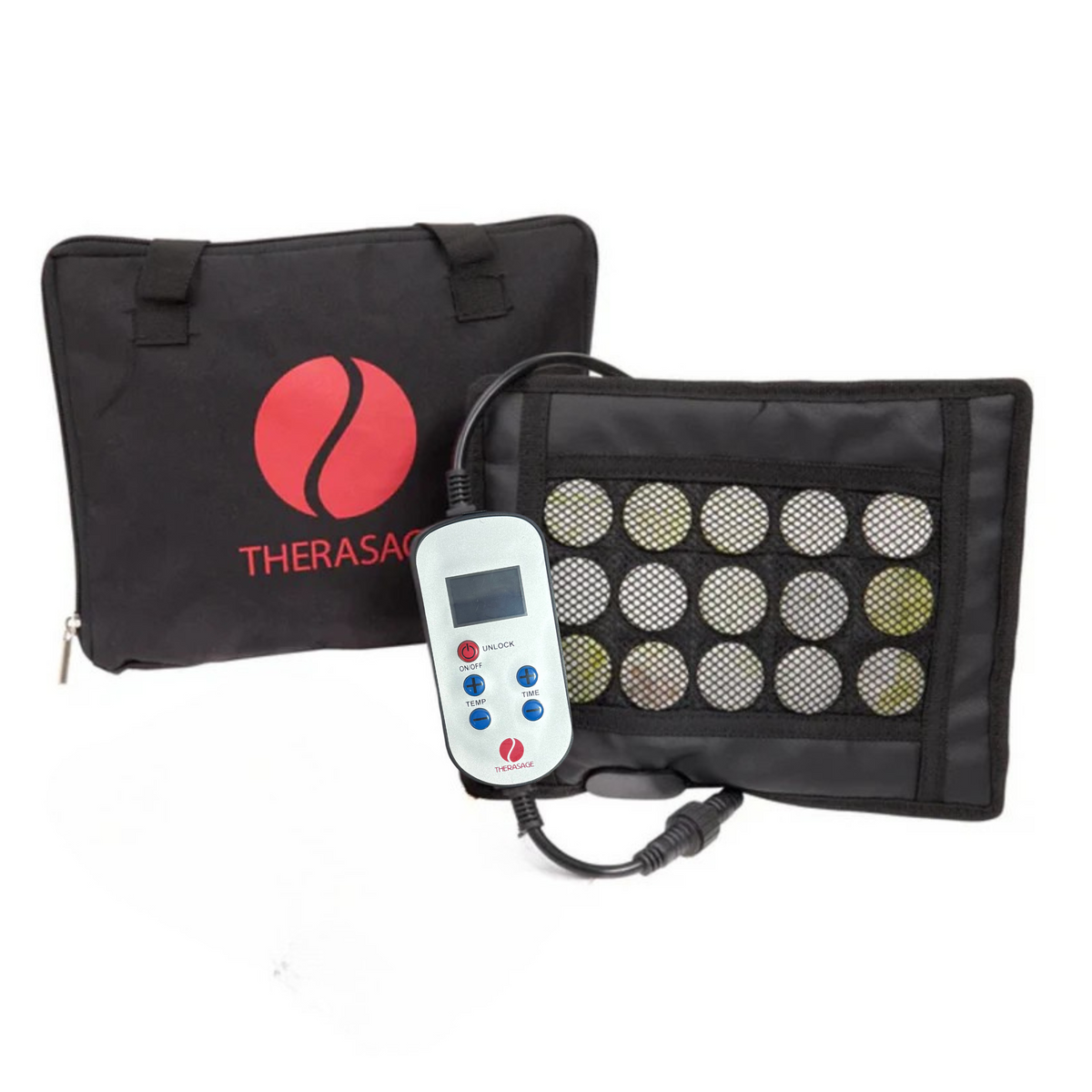
The current Therasage Healing Pad guides give model-specific directions for placement, temperature, session length, and skin protection. These pads provide full-spectrum infrared heat through gemstone-based formats. Product features and comfort do not make research on unrelated heat, massage, or recovery protocols product-specific evidence.
If you use red light, see original topics 16 and 19. Wavelength, dose, distance, and timing matter, and a study on one photobiomodulation device cannot be transferred automatically to another.
Train around soreness instead of proving toughness
Before the next session, check a bodyweight version of the planned movement. Can you use your usual range and control? Is soreness symmetrical and located in the muscles you trained? Does a warm-up improve the feeling, or does pain sharpen as load increases?
If movement quality is clearly reduced, train a different area, lower the demand, or take another recovery day. The goal is not to eliminate every sensation; it is to avoid compensating so much that you expose another tissue to an unfamiliar load.
Warning signs that are not ordinary DOMS
Get urgent medical help for dark brown or tea-colored urine, severe or rapidly increasing swelling, profound weakness, confusion, fainting, reduced urination, or feeling very unwell after exercise. These may occur with rhabdomyolysis, heat illness, or another serious problem.
Have pain assessed when it is sharp and localized, linked to a specific injury, accompanied by major bruising or instability, or fails to begin improving. Chest pain, severe shortness of breath, or neurological symptoms require prompt care.
Frequently asked questions
Does soreness mean muscle growth
No. Soreness shows that the session was unfamiliar or demanding enough to create a response; it does not measure hypertrophy or workout quality.
Can I exercise with DOMS
Often you can use gentle activity or train less-affected areas. Reduce demand if soreness changes technique, range, coordination, or strength. Do not train through warning signs.
Should I take pain medicine for soreness
Medication decisions depend on your health, other drugs, and the severity and cause of pain. Ask a pharmacist or clinician rather than taking anti-inflammatory medicine automatically after every workout.
How can I avoid being this sore next time
Progress load, volume, speed, and unfamiliar eccentric exercise gradually. A modest first session often creates a better week of training than an ambitious session followed by several lost days.
Your next step
Rate today’s soreness and test one easy movement. If control improves as you warm up, choose light activity and reduce the next load. If you use warmth for comfort, follow the exact Therasage Healing Pad guide for your model. If symptoms are focal, severe, or accompanied by weakness, swelling, or dark urine, stop treating them as ordinary soreness and seek care.
References
1. Cheung K, Hume P, Maxwell L. Delayed onset muscle soreness: treatment strategies and performance factors. Sports Medicine. 2003;33:145–164.
2. Dupuy O et al. An Evidence-Based Approach for Choosing Post-exercise Recovery Techniques. Frontiers in Physiology. 2018;9:403. Systematic review and meta-analysis.
3. Herbert RD et al. Stretching to prevent or reduce muscle soreness after exercise. Cochrane Database of Systematic Reviews. 2011;CD004577.
4. Therasage. Healing Pad and TheraPro user guides. Checked September 18, 2026; product and operating source only.