

Inflammation gets blamed for nearly everything: sore joints, low energy, slow recovery, skin changes, and chronic disease. So a device described as “anti-inflammatory” can feel like an answer to many problems at once. The trouble is that inflammation is a biological process, not a single sensation—and it is not always harmful.
Red and near-infrared photobiomodulation can alter inflammatory pathways in laboratory and animal studies, and some human trials report changes in selected biomarkers or symptoms. That does not prove that an at-home red-light device treats “systemic inflammation” or an inflammatory disease. The evidence must be matched to a specific condition, protocol, and patient-centered outcome. Hamblin, 2017.
This article is about asking better questions. It is not a diagnosis, and it is not a reason to delay care for persistent symptoms.
Inflammation is a response not a wellness score
Inflammation helps the body respond to infection and injury. Acute redness, warmth, swelling, and pain can be part of repair. Chronic inflammatory activity can also contribute to disease, but the cause and treatment depend on the condition. Rheumatoid arthritis, an infected wound, delayed-onset muscle soreness, and inflammatory bowel disease cannot responsibly be grouped under one home remedy.
You also cannot reliably identify “high inflammation” from fatigue or stiffness alone. Clinicians combine history, examination, and—when appropriate—tests. Even common blood markers such as C-reactive protein are nonspecific; they can show that an inflammatory process may be present without explaining why.
That is why a claim about a cytokine in tissue or a blood marker after exercise is not the same as demonstrated improvement in pain, function, flare frequency, or disease progression.
What biological research suggests
A widely cited mechanistic review describes how photobiomodulation may influence mitochondrial signaling, reactive oxygen species, transcription factors, and inflammatory mediators. Across experimental models, effects can differ between resting cells and already activated inflammatory cells. The authors also discuss dose-dependent responses. Mechanisms and applications review.
This work supports biological plausibility: light can interact with tissue in ways that affect signaling. But much of the mechanistic evidence comes from cells or animals. A change in an animal cytokine after a carefully delivered laboratory dose is a clue for human research, not a consumer outcome.
Mechanism is often where marketing skips ahead. “May influence a pathway” becomes “detoxifies inflammation,” even though no such clinical endpoint was tested. A trustworthy explanation keeps those steps separate.
Biomarkers symptoms and outcomes are different layers
Consider an exercise-recovery study that measures creatine kinase, lactate, interleukin-6, soreness, and strength. A lower blood marker may be interesting, but readers usually care whether they hurt less or can return to normal activity. Ideally, a study reports both and shows a meaningful difference against a suitable control.
A 2015 systematic review of laser and LED trials around exercise found favorable results for some performance measures and reported positive findings in several biomarker comparisons. However, heterogeneous study designs prevented pooled analysis of the biochemical markers. Leal-Junior and colleagues, 2015. That means the biomarker story was not one uniform, confirmed effect.
A later review of 39 trials found some effects favoring phototherapy for fatigue and performance, but rated the evidence from very low to moderate quality and emphasized small samples, varied exercise protocols, and varied light parameters. Vanin and colleagues, 2018.
These reviews are relevant to exercise-related responses. They do not establish treatment for autoimmune disease, cardiovascular inflammation, or an unexplained elevated lab result.
Why dose and target prevent a universal claim
Photobiomodulation is not one dose. Researchers specify wavelength, irradiance, energy, area, distance, treatment time, number of sessions, and timing relative to an event. Tissue depth and skin characteristics can affect the light that reaches a target. A low dose may have no meaningful effect; an increasingly high dose is not automatically more beneficial.
Even the word “systemic” needs care. Applying light to one knee and measuring a blood marker does not prove whole-body disease modification. A full-body device also does not guarantee a systemic clinical result merely because it covers more skin.
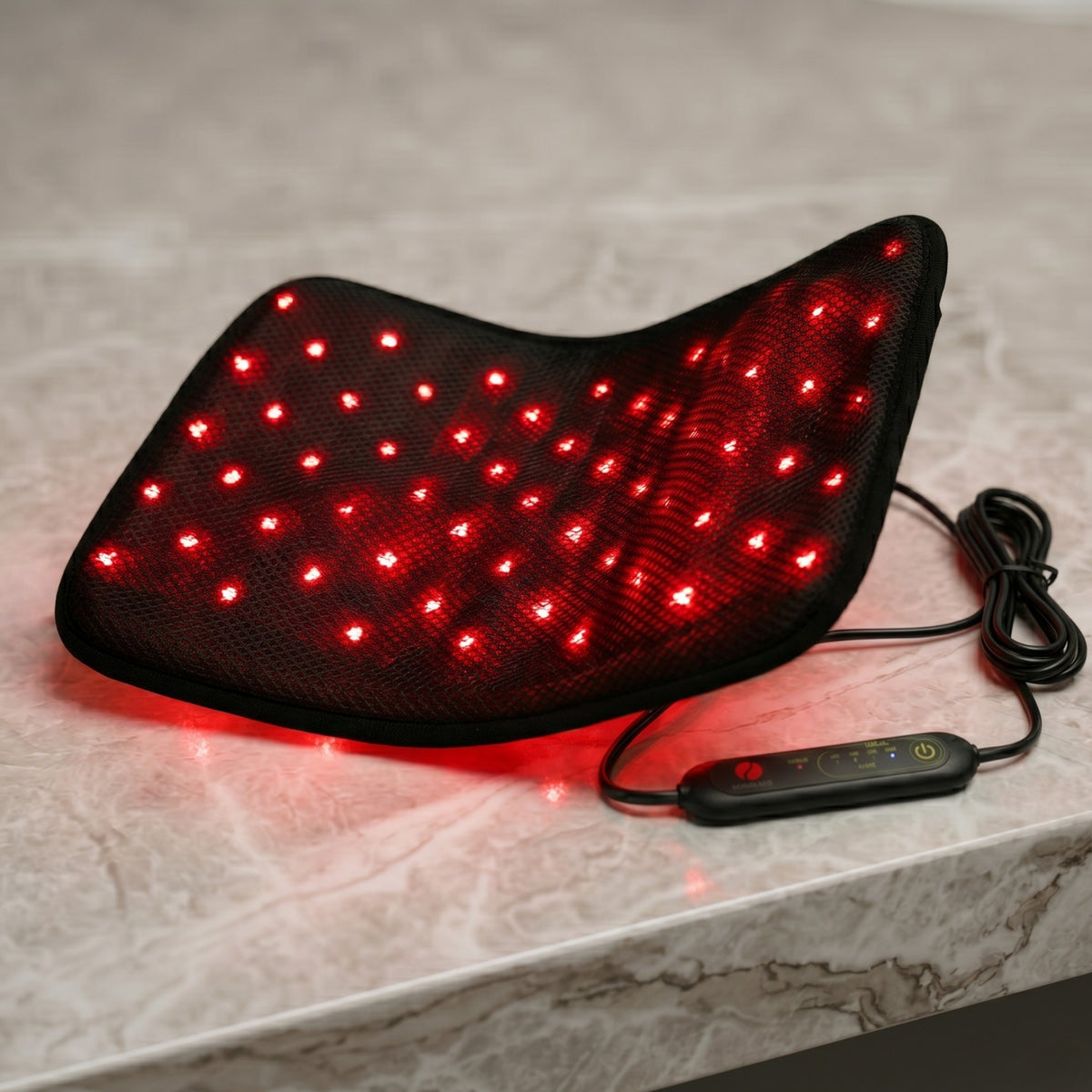
The current Therasage Tri-Lite product page describes a portable flexible panel with red and near-infrared LEDs for targeted face or body use. It provides product-specific dimensions and operating guidance. It should not be represented as the device used in every study or as a treatment for an inflammatory diagnosis.
How to translate the evidence into a sane home routine
Begin with the problem you can describe. “My quadriceps are sore after an unfamiliar workout” is different from “my joints are swollen every morning.” The first may be a short-lived recovery question; the second may require medical evaluation.
If a clinician has identified a condition and agrees that photobiomodulation is a reasonable adjunct, use the exact product instructions. Do not improvise treatment over the thyroid, eyes, suspicious lesions, or areas where sensation is impaired. Review medicines and conditions that cause photosensitivity. The American Academy of Dermatology notes that short-term use appears generally safe when instructions are followed while long-term effects remain under study. AAD guidance.
Choose an outcome that matters: swelling measured consistently, pain during a defined task, morning-stiffness duration, or recovery of strength. Do not order repeated inflammatory blood tests solely to validate a wellness routine unless a clinician recommends them. More data is not always more understanding.
When inflammation needs medical attention
Seek prompt care for fever with a hot or rapidly swelling joint, spreading redness, breathing difficulty, facial swelling, a severe allergic reaction, or signs of infection. Persistent joint swelling, unexplained weight loss, recurring fever, blood in stool, or worsening symptoms deserve assessment. Red light should not mask a reason to investigate.
If you already have an inflammatory or autoimmune disease, keep prescribed treatment in place unless the treating clinician changes it. Feeling better after a session is welcome, but it is not evidence that underlying disease activity is controlled.
Frequently asked questions
Can red light lower C reactive protein
Some research measures inflammatory markers, but there is no general promise that a home device will lower CRP or that doing so would treat the cause of an elevated result. CRP belongs in clinical context.
Is soreness after exercise the same as inflammation
Exercise can trigger inflammatory and repair responses, but soreness is a subjective symptom influenced by many processes. A biomarker change and a meaningful improvement in soreness or function should be reported separately.
Does warmth from a light panel prove inflammation is decreasing
No. A sensation of warmth may be comfortable, but it is not a measurement of inflammatory activity. Red-light photobiomodulation is also distinct from infrared heating, even when a device or routine includes both.
Can I use red light during an autoimmune flare
Ask the clinician managing the condition. Evidence and risks vary by disease, medication, treatment area, and device. Do not replace prescribed flare management with a consumer device.
Your next step
Replace the broad goal “reduce inflammation” with one specific, observable question. If red light fits safely beside your existing care, follow the manual and track a meaningful symptom or function rather than chasing an invisible promise. Review the Tri-Lite panel for current specifications and operation, while keeping clinical decisions with the professional who knows your health history.
References
1. Hamblin MR. Mechanisms and applications of the anti-inflammatory effects of photobiomodulation. AIMS Biophysics. 2017;4:337–361. Mechanistic review with substantial preclinical evidence.
2. Leal-Junior ECP et al. Effect of phototherapy on exercise performance and markers of exercise recovery. Lasers in Medical Science. 2015;30:925–939. Systematic review and meta-analysis.
3. Vanin AA et al. Photobiomodulation for muscular performance and fatigue. Lasers in Medical Science. 2018;33:181–214. Systematic review and meta-analysis.
4. American Academy of Dermatology. Is red light therapy right for your skin?. Consumer safety context.
5. Therasage. Thera Tri-Lite panel and user guides. Checked September 18, 2026; product and operating sources only.