

The bathroom mirror catches every late night and every bright overhead bulb. If you are considering red light for fine lines, you may be hoping for a gentle option—but still want to know whether the before-and-after photographs are supported by more than lighting and optimism.
Small controlled studies suggest that certain red and near-infrared light protocols can produce modest improvements in fine lines, skin roughness, elasticity, or collagen-related measurements. Evidence for home devices is still developing, results vary, and red light does not replace daily sun protection or dermatologist-directed care. American Academy of Dermatology.
The goal is not to talk you out of enjoying a skincare ritual. It is to place that ritual in a realistic plan, with enough time to judge it and enough caution to protect your eyes and skin.
What photobiomodulation is trying to influence
Red and near-infrared light used for photobiomodulation is non-ionizing and does not use the ultraviolet wavelengths responsible for tanning. Laboratory research suggests that particular light exposures can affect cellular signaling and processes related to tissue repair. In skin research, investigators may examine collagen density, elasticity, hydration, roughness, wrinkle scores, or participant satisfaction.
These outcomes are not interchangeable. A biopsy or ultrasound measurement of collagen is a biological or structural result. A blinded wrinkle grade is a visible clinical assessment. Participant satisfaction matters, but it is vulnerable to expectations. Stronger studies define outcomes in advance and include a sham or comparison group.
Also remember that a plausible mechanism is not a guaranteed mirror result. The light must reach the intended tissue at a suitable dose, and skin aging reflects UV exposure, genetics, hormones, smoking, movement, and time—not one pathway.
What a controlled trial found
A 2014 controlled trial enrolled 136 volunteers and compared two large-area red or red-plus-near-infrared light sources with an untreated control group. Participants received 30 treatments over 15 weeks. The researchers reported improvements in participant-rated complexion, measured skin roughness, wrinkle measures, and intradermal collagen density in treated groups. Wunsch and Matuschka, 2014.
The study offers useful human evidence, but it does not establish that every mask or panel will produce the same result. It tested particular devices, exposure schedules, and outcomes. The control group received no light rather than a convincing sham exposure, making expectation and treatment-experience differences harder to exclude. The trial was also connected to device development, which belongs in a full assessment of potential bias.
This is why “a study found improvement” and “this product is proven to erase wrinkles” are very different statements.
What dermatologists tell consumers
The American Academy of Dermatology says research suggests red-light therapy may produce subtle to noticeable improvements in signs of skin aging for some people. It also stresses that at-home devices are less powerful than in-office devices, results vary, and more study is needed—especially regarding long-term effects. FDA clearance addresses a device’s regulatory pathway and safety context; it is not a promise of a particular cosmetic result. AAD consumer guidance.
The AAD also recommends following instructions, using eye protection when directed, and talking with a dermatologist if you have a photosensitive condition or take a medicine that increases light sensitivity. Those details matter more than copying another person’s frequency from social media.
Expect weeks not an instant filter
Skin remodeling is gradual. The 2014 trial delivered repeated treatments over 15 weeks, not one dramatic session. A home routine should be evaluated on the timeline in its instructions and any product-specific evidence—not an arbitrary promise that everyone will see a change by day seven.
Take standardized photos if you want to assess visible change: same room, distance, angle, time of day, facial expression, camera settings, and skincare state. Avoid judging immediately after a session, when temporary warmth or flushing can change appearance. Do not use smoothing filters or different lighting.
Decide what “worth it” means before you start. A small change in texture may be worthwhile if the routine is comfortable and affordable. It may not be worthwhile if it causes irritation, consumes time you resent, or encourages you to skip proven sun protection.
Keep the foundation simple
Daily broad-spectrum sunscreen, shade, protective clothing, and avoiding tanning reduce further UV-related skin damage. A moisturizer can temporarily improve the appearance of dryness and fine lines. For more substantial concerns, a board-certified dermatologist can discuss evidence-based topical or procedural options and help distinguish normal aging from a lesion that needs evaluation.
Red light should not be used over a suspicious or changing spot as a way to “see if it improves.” Follow the ABCDE warning signs for melanoma and seek evaluation for a new, changing, bleeding, or non-healing lesion. Cosmetic goals never outrank a skin-cancer check.
Match the device to the question
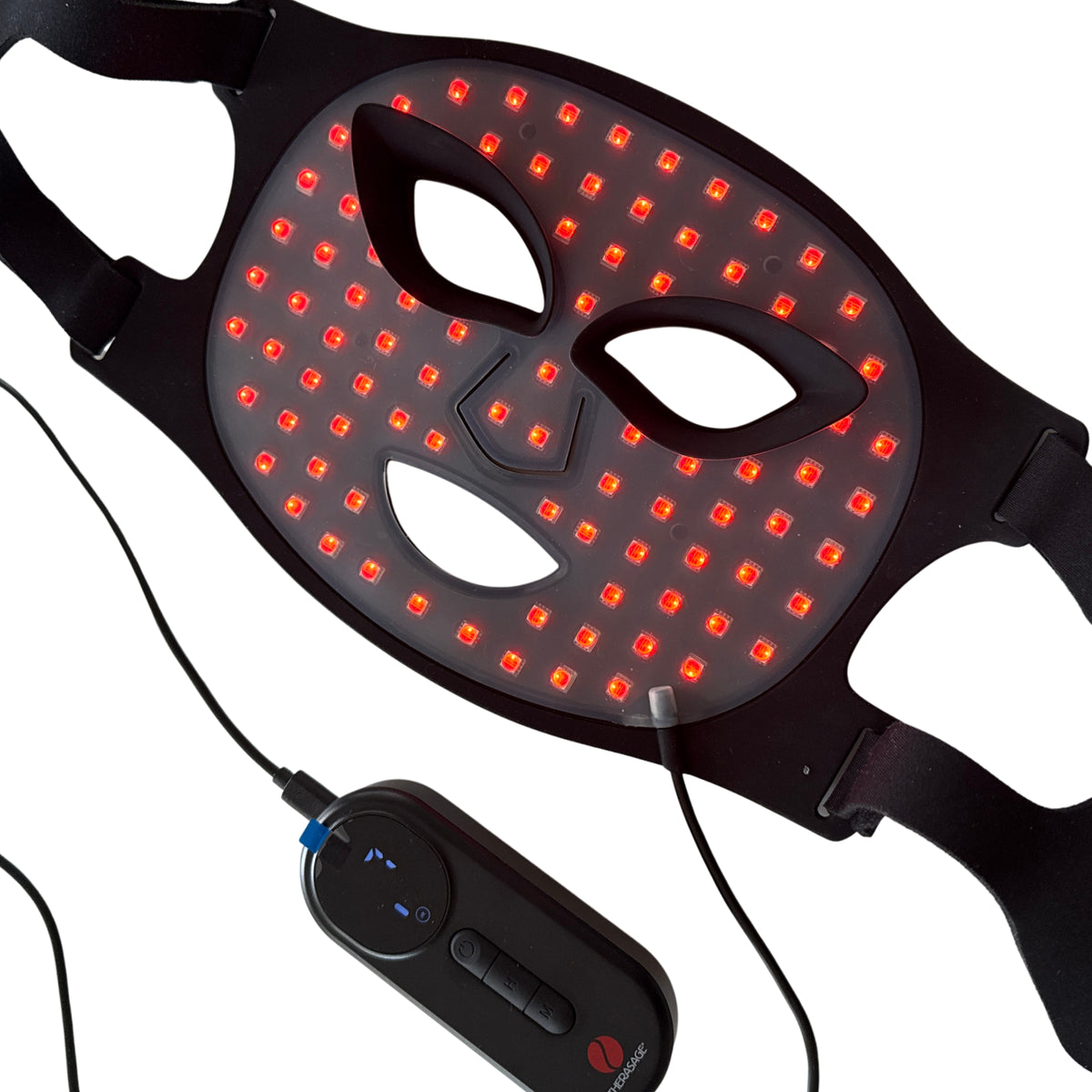
Masks sit close to facial contours; panels may cover the face or another body area from a specified distance. Neither format is automatically superior. Fit, wavelength, irradiance at the skin, session time, eye protection, and whether the device has evidence for the intended use all matter.
The current Therasage Tri-Lite page describes a flexible 9 by 13.5 inch red and near-infrared LED panel for targeted face or body use. It includes device-specific instructions and recommends a gradual start for above-the-neck use. Those are useful operational facts. They do not mean the panel was the equipment used in the 2014 trial.
Use the manufacturer’s manual, not a study’s timing for a different device. Do not assume that placing a panel closer or using it longer accelerates collagen change. More is not automatically better, and skin or eye symptoms are reasons to stop and reassess.
Frequently asked questions
Does red light erase wrinkles
No. Studies describe average changes in selected outcomes, generally after repeated treatment. “Erase” overstates the evidence and ignores differences in wrinkle depth, skin, device, and protocol.
Is red light the same as UV light
No. Red and near-infrared photobiomodulation does not use tanning wavelengths. That distinction does not remove the need to follow eye and device safety instructions.
Can I use retinoids with a red light device
Ask your dermatologist or pharmacist about your exact topical product and device. Some ingredients or medicines can increase irritation or light sensitivity, and directions differ.
Will a collagen measurement mean I look younger
Not necessarily. A structural measurement can support a biological effect, but visible appearance and personal satisfaction are separate outcomes. Good studies report them separately.
Your next step
Keep sunscreen as the non-negotiable, then decide whether a consistent light routine fits your expectations and budget. Photograph your baseline under repeatable conditions and follow the device guide rather than chasing faster results. If a flexible panel suits your routine, review the Tri-Lite for current specifications and operating guidance, and bring medical or medication questions to a dermatologist.
References
1. American Academy of Dermatology. Is red light therapy right for your skin?. Consumer evidence and safety guidance.
2. Wunsch A, Matuschka K. A controlled trial of red and near-infrared light for fine lines, wrinkles, skin roughness, and collagen density. Photomedicine and Laser Surgery. 2014;32:93–100.
3. American Academy of Dermatology. How to select a sunscreen. Foundational photoprotection guidance.
4. American Academy of Dermatology. ABCDEs of melanoma. Skin-cancer warning signs.
5. Therasage. Thera Tri-Lite panel and user guides. Checked September 18, 2026; product and operating sources only.