

You want red light to fit into real life, not become another device that looks impressive in a cabinet. A face mask promises hands-free simplicity. A panel promises flexibility. Product pages may compare power, wavelengths, and LED counts until the practical question disappears: which format will you use correctly and consistently for your goal?
Choose a mask when your main goal is facial skincare and you value a consistent, close-fitting setup. Choose a panel when you want to treat different face or body areas and can reproduce the stated distance and position. Neither format is inherently more effective; wavelength, delivered dose, coverage, fit, evidence, and correct use matter more than the category name. American Academy of Dermatology.
Here is a grounded way to decide without turning the comparison into a wattage contest.
Start with the treatment area
A mask is shaped for the face. Its geometry can make placement repeatable: the LEDs sit in a similar relationship to your skin each time, provided the mask fits comfortably. It is less adaptable for a shoulder, thigh, or lower back.
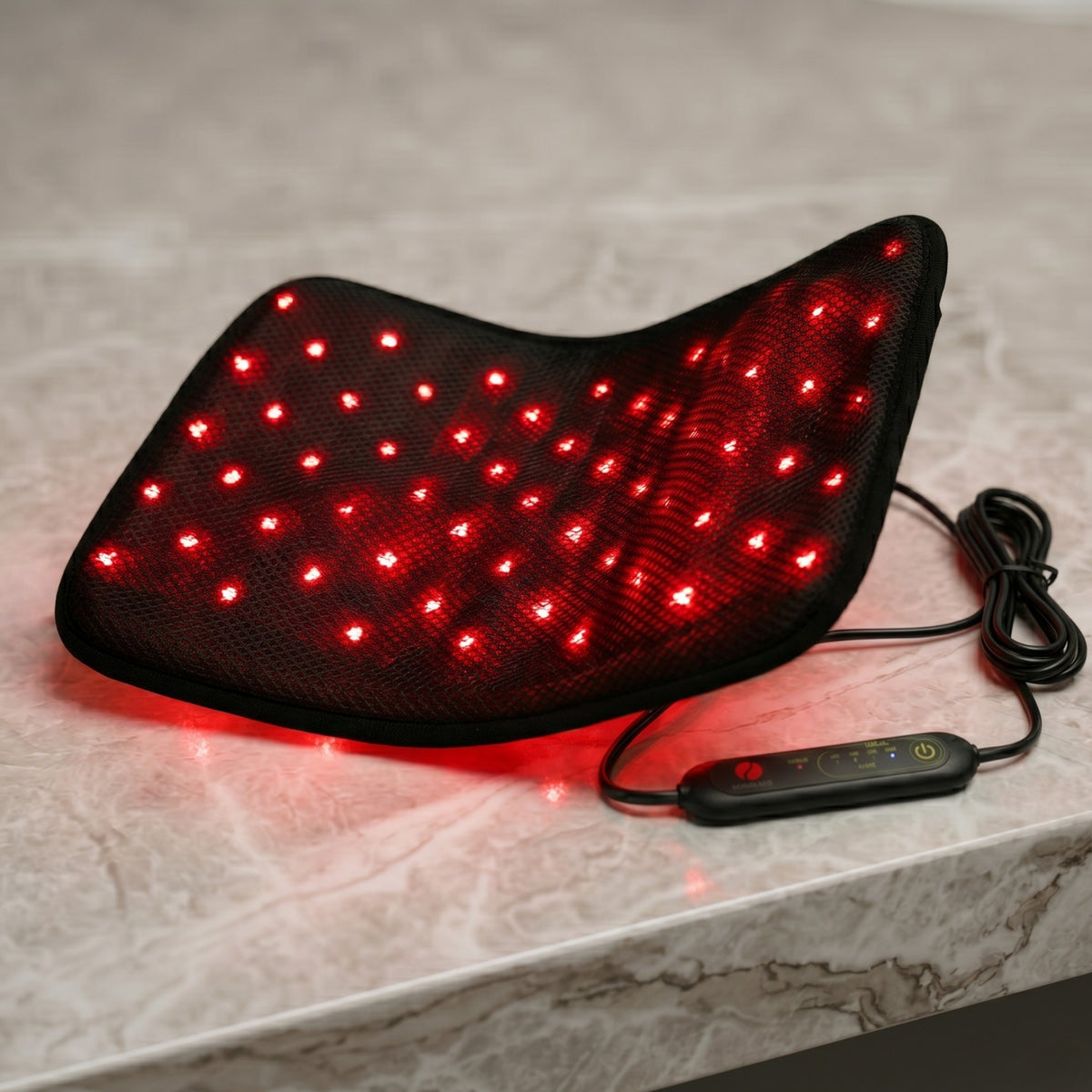
A panel covers an area in front of it or, if flexible and designed for contact, may curve around a body region. It can serve more than one goal, but repeatability becomes your responsibility. Distance, angle, and position may change between sessions.
If 90 percent of your interest is facial skincare, a face-specific device may remove friction. If your household wants a device for a knee, back, shoulder, and face, a versatile panel may be more practical. Buying the larger category does not guarantee that it will fit your daily routine.
Fit and distance change the exposure
Light intensity at the skin depends partly on distance and geometry. A mask designed to sit near the face is not used like a freestanding panel across the room. A panel’s stated irradiance may be measured at one distance, while real use at another distance delivers something different.
Contours also create shadows. A well-designed mask may follow the cheeks and jaw, but noses, straps, hair, and fit can still influence coverage. A panel may cover a broader field, but the sides of the face may receive less direct light when you face straight ahead.
Do not compare an irradiance number without checking where and how it was measured. LED count, brightness, and electrical wattage are not substitutes for delivered dose at the skin.
Compare the routine not only the specification sheet
Ask yourself:
- Can I sit at the required distance without drifting closer or farther away?
- Does the mask feel comfortable across my nose, ears, and straps?
- Can I follow the eye-protection instructions every time?
- Is the controller simple enough that I will select the intended mode rather than guessing?
- Can the device be cleaned between uses as directed?
- Will the session fit the part of the day when I am realistically available?
A portable mask may let you move around, but movement is not always an advantage if the instructions expect a stable position. A panel may feel less enclosed and may be easier to share hygienically, but it needs a reliable setup location.
The best device is not the one with the longest feature list. It is the one whose correct use is clear enough to repeat.
What research can and cannot tell you
The AAD notes that home red-light devices come as masks, panels, wands, caps, and other formats. Studies use different devices, schedules, and outcomes, making comparisons difficult. At-home products are generally less powerful than in-office equipment, and red light is often used as a complementary treatment rather than a complete skincare plan. AAD consumer guidance.
A study that improved fine lines with a particular large-area light source does not prove that a mask is inferior. A study using a face mask does not prove that every mask shares its result. Direct head-to-head clinical trials between consumer formats are limited, so format comparisons should focus on physical design and verified specifications unless product-specific outcome data exist.
FDA clearance also needs accurate language. As the AAD explains, clearance indicates a low-risk regulatory determination; it does not promise that a device will deliver the cosmetic result you want.
A current Therasage example
The current TheraGlow Mask2Go is a flexible, face-contouring device with a rechargeable controller, adjustable intensity, and multiple colored-light modes. Its listed dimensions are approximately 11.44 by 7.45 inches, and the page identifies 88 LED bead sets. These are product features, not proof of a particular clinical result.
The current Thera Tri-Lite panel is a flexible 9 by 13.5 inch red and near-infrared panel intended for targeted face or body use. It can be positioned on different areas and uses a controller. Again, versatility is a design feature; it does not make studies on unrelated panels product evidence.
For a facial-skincare goal, compare fit, modes, eye comfort, and cleaning. For a face-and-body goal, compare coverage, placement, and the time required to treat multiple areas. Use the current guide for whichever product you select.
Safety should break a tie
Choose a device with clear instructions, a transparent intended use, and eye-protection guidance. Do not substitute sunglasses when protective goggles are specified. Stop for persistent irritation, pain, headache, or visual symptoms.
Talk with a dermatologist before home use if you have a photosensitive disorder, take a photosensitizing medication, have melasma or a history of pigment changes, or want to treat a skin condition. The AAD notes that darker skin tones may be more sensitive to visible light and may be at greater risk of hyperpigmentation.
Do not shine light over a suspicious lesion in place of having it examined. A mask that covers the face can make it especially important to check the skin beforehand.
Frequently asked questions
Is a panel stronger than a mask
Not necessarily. Strength cannot be determined by format alone. Compare verified irradiance at the intended distance, treatment area, session instructions, and device-specific evidence.
Does a mask give more even facial coverage
Its contour may make placement more repeatable, but fit varies and facial features can create shadows. A panel may cover a broad field but requires stable distance and angle.
Can I use a body panel on my face
Only if the manufacturer says the device is intended for facial use and you follow its above-the-neck, distance, duration, and eye-safety instructions.
Can one device replace a dermatologist
No. A consumer light can be part of a routine, but it cannot diagnose a rash, pigment change, hair-loss cause, or suspicious lesion.
Your next step
Write down the first two areas you genuinely plan to treat. If the answer is “face and face,” compare the Mask2Go with your skincare routine. If the answer includes body areas, compare the Tri-Lite panel for placement and coverage. Then read the complete guide before buying. A format that fits your life is more useful than an impressive device you cannot use consistently.
References
1. American Academy of Dermatology. Is red light therapy right for your skin?. Updated September 13, 2024.
2. Wunsch A, Matuschka K. Controlled trial of red and near-infrared light for fine lines, wrinkles, skin roughness, and collagen density. Photomedicine and Laser Surgery. 2014;32:93–100. Device-specific trial, not a mask-versus-panel comparison.
3. Therasage. TheraGlow Mask2Go, Thera Tri-Lite panel, and user guides. Checked September 18, 2026; product and operating sources only.